Householder Transformation
Multi-dimensional Vector Rotation via Householder Transformation
We consider a \(d\)-dimensional space, illustrated here in 3D to aid understanding, focusing on a single sub-vector of the reconciliation frame. The aim is to provide a visual understanding of the Householder transformation, i.e. the mechanism that enables a virtual channel in arbitrarily high dimensions. For clarity and pedagogical purposes, we present the standard construction, which has computational complexity \(O(d^3)\).
1. Transmission
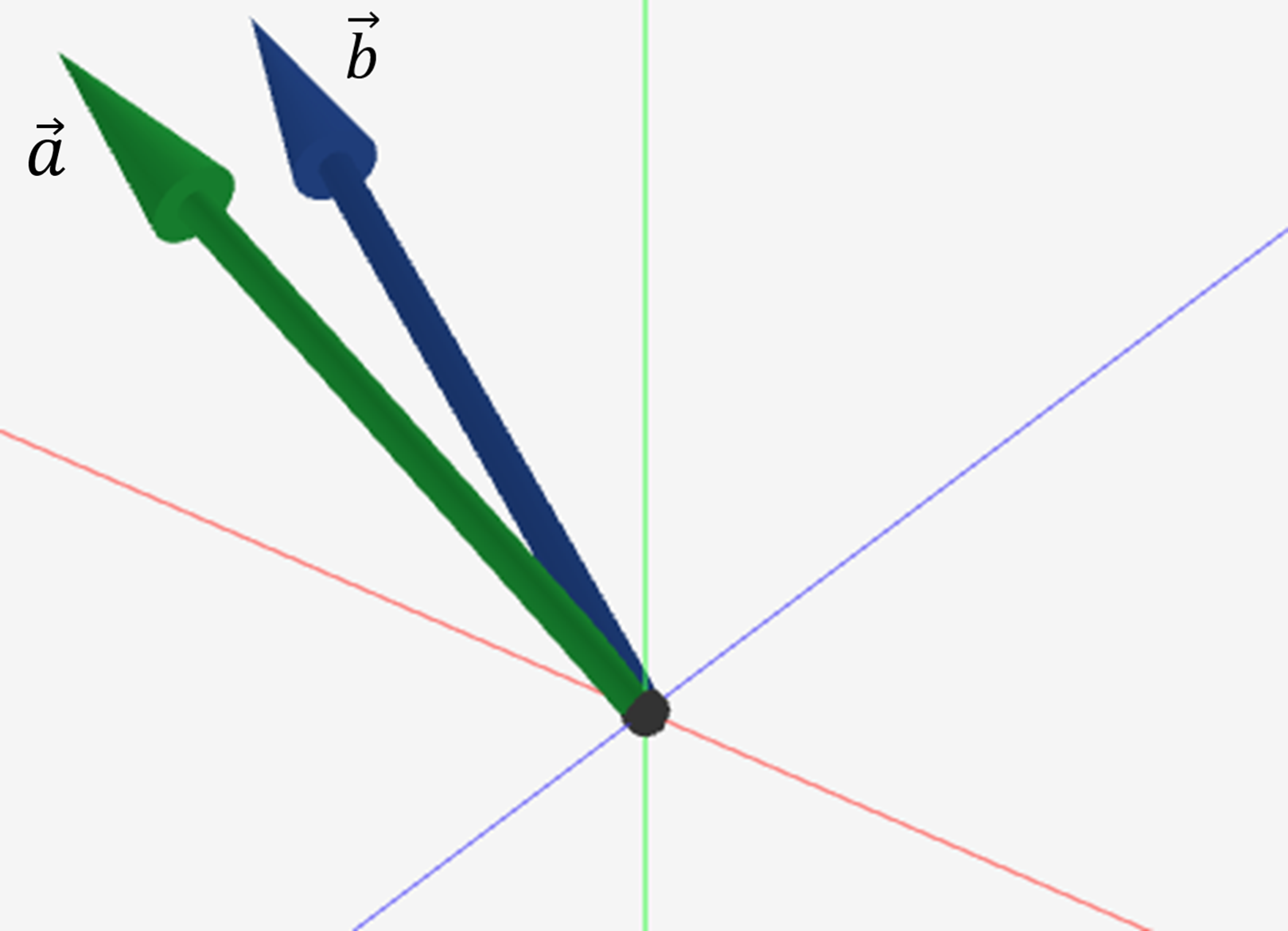
Alice sends a vector \(\vec{a}\), and Bob receives a noisy version \(\vec{b}\).
2. Key Representation
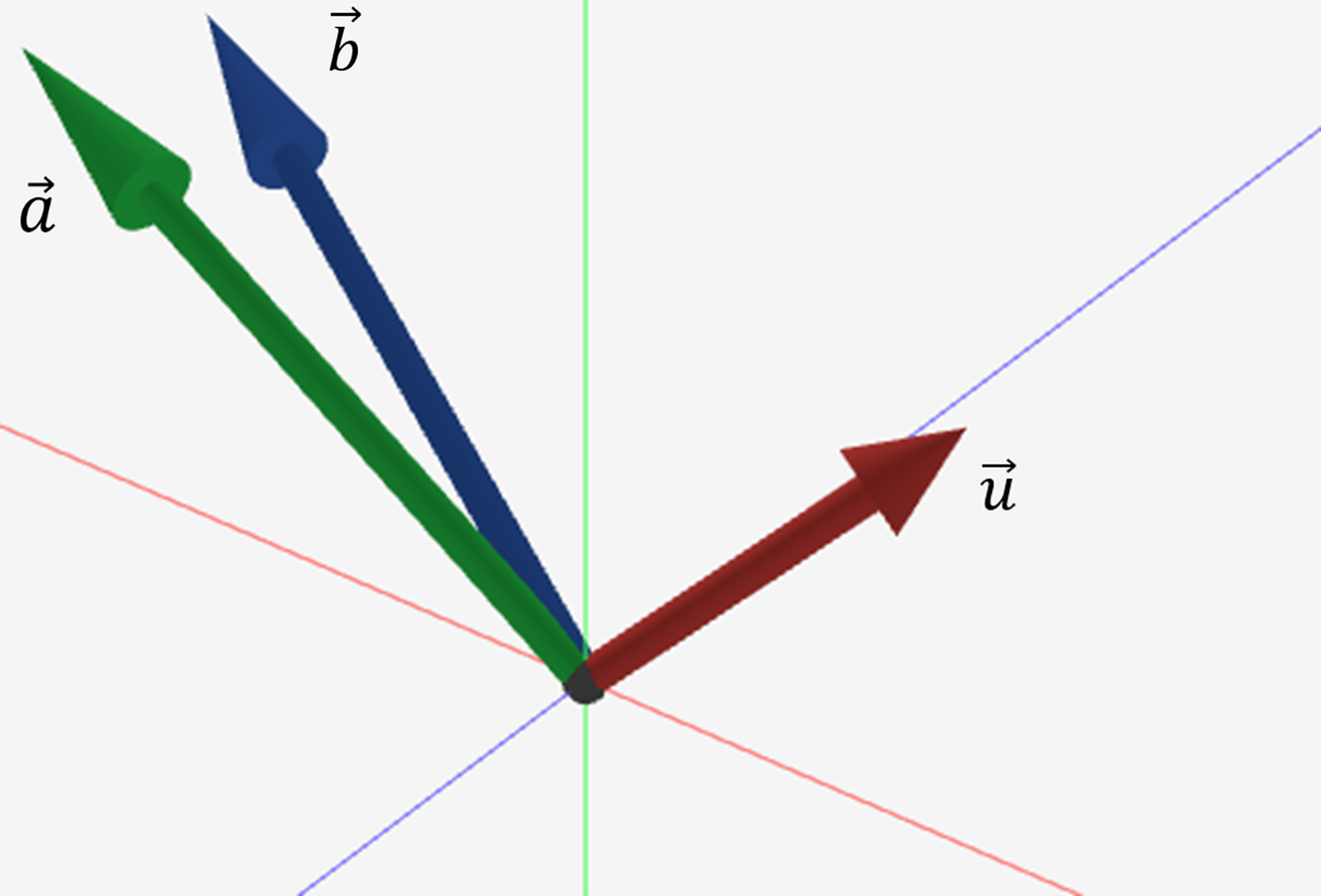
Bob generates a vector \(\vec{u}\), which encodes the target key.
3. Norm Scaling
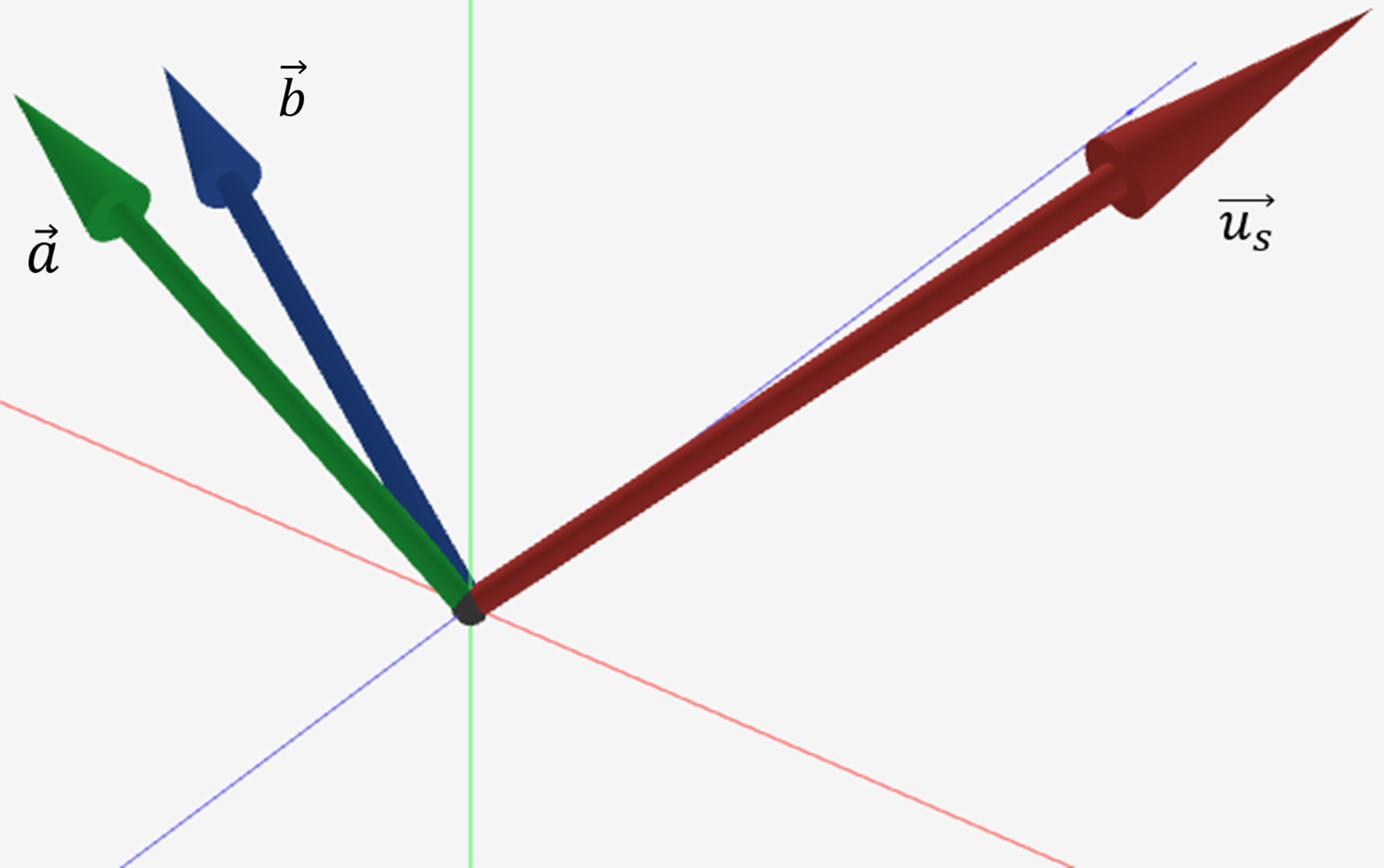
Bob rescales \(\vec{u}\) so that \(\|\vec{u}\| = \|\vec{b}\|\).
This ensures the transformation between them can be purely orthogonal.
4. Randomisation
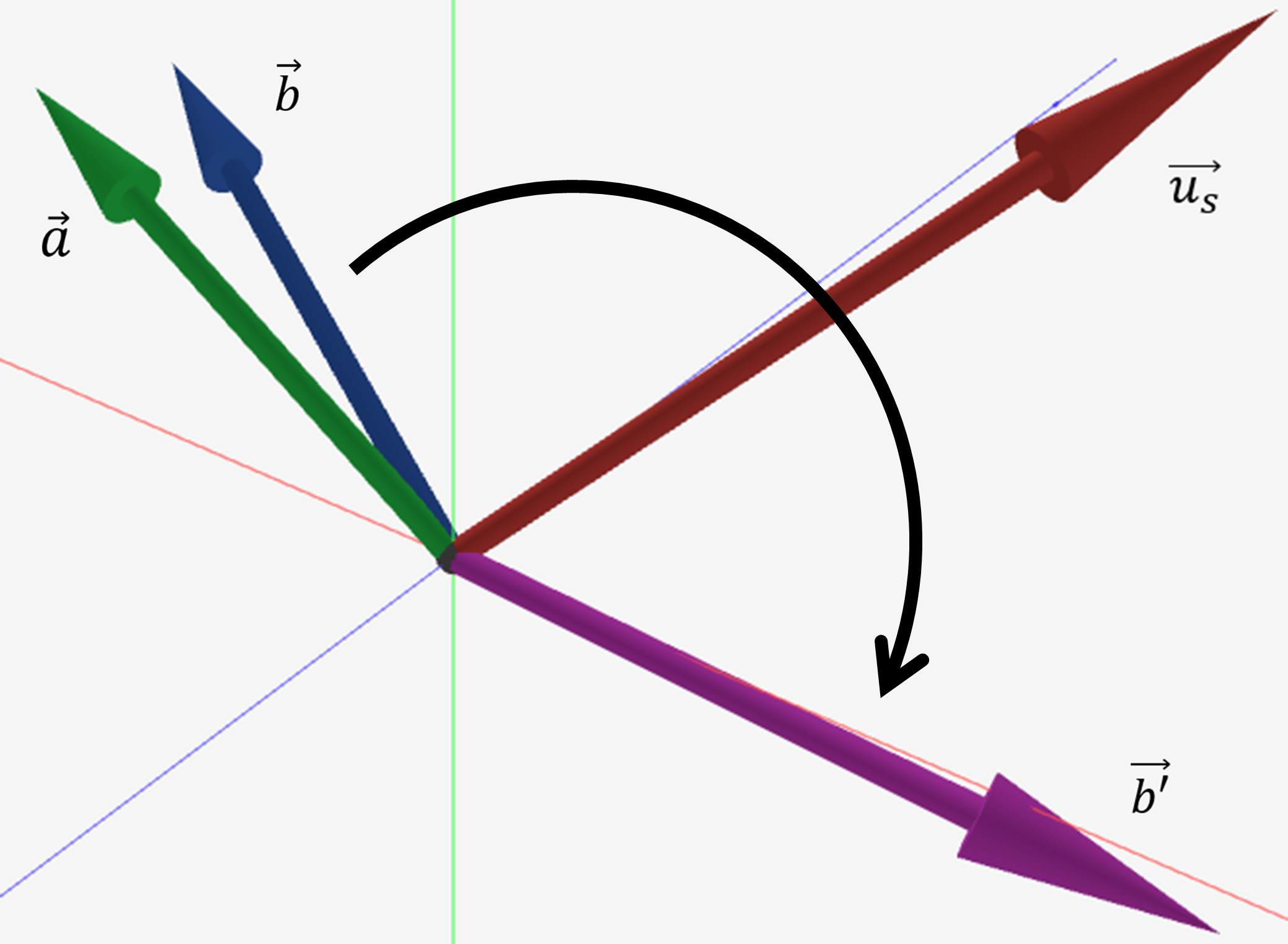
Bob applies a random rotation to \(\vec{b}\), producing \(\vec{b}'\).
This step hides structural information and introduces randomness.
5. Householder Construction
Bob computes a Householder transformation that maps \(\vec{b}'\) to \(\vec{u_s}\).
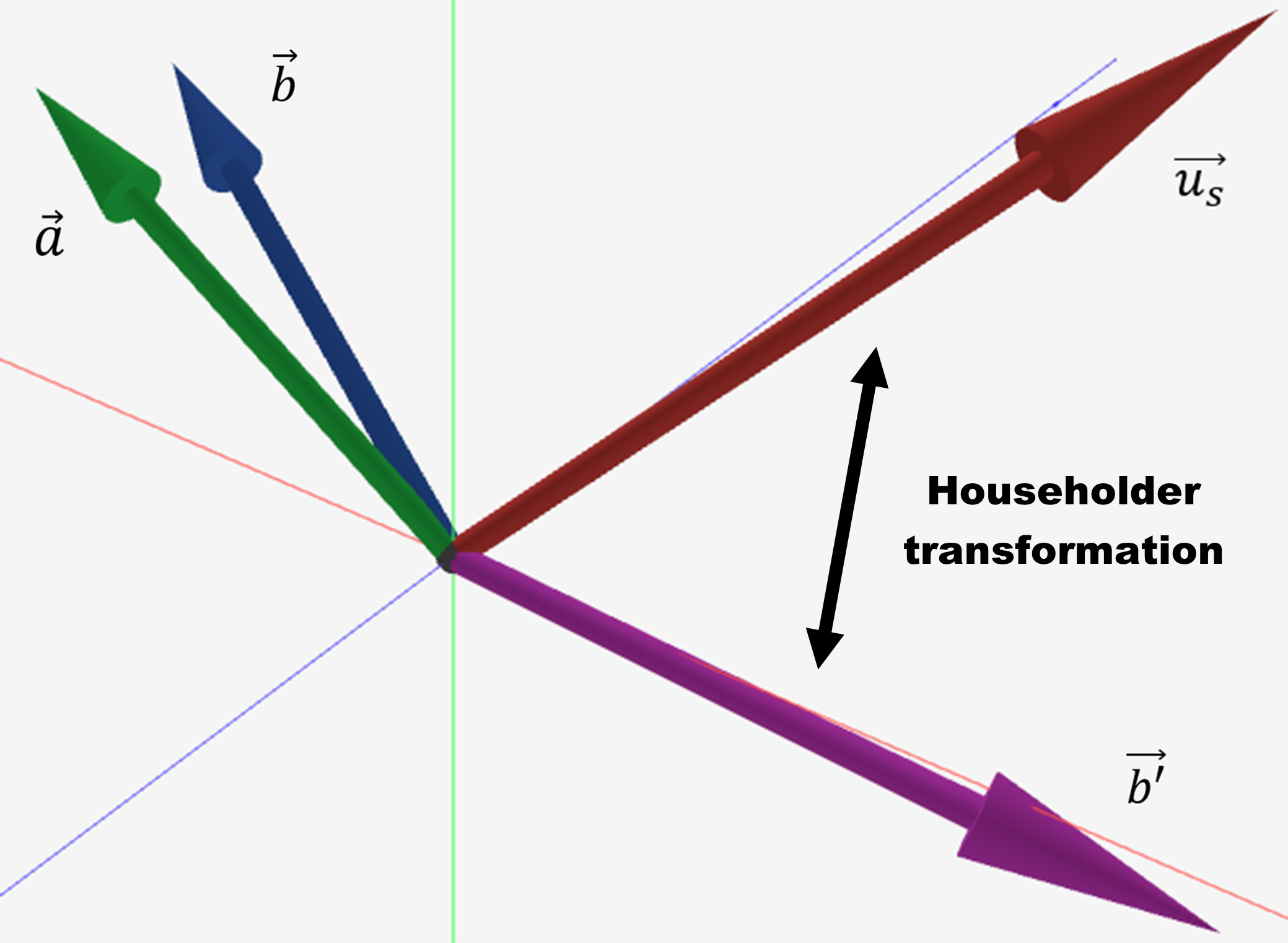
A Householder matrix is defined as:
where:
This transformation reflects \(\vec{b}'\) onto \(\vec{u_s}\).
6. Final Random Orthogonal Matrix
By composing the random rotation and the Householder reflection, Bob obtains a single orthogonal matrix that maps the original \(\vec{b}\) to \(\vec{u_s}\).